Tutoring tracker template (.xlsx)
Four tabs — Students, Lessons, Payments and Balance — that open in Excel, Numbers and Google Sheets.
Tutoring income calculator
Example numbers — enter your own
This is an estimate, not a promise: statutory holidays, March break and sick days make every month a little different.
Your students
Type your students and prices — the template downloads with them and ready-made formulas.
How to set up the template in five minutes
Start with the Students tab: name, price per lesson, phone or email, and a note — for example, when their provincial exam is. Then every lesson you teach becomes one row on the Lessons tab, and every payment one row on the Payments tab.
Type the price into each lesson row. That way, when you raise your rate, past lessons keep the old price and old balances stay put. Spell names the same way everywhere: to a spreadsheet, "Emma Wilson" and "Emma W." are two different people.
What the formulas on the Balance tab do
Paid is the total of a student's payments. Charged is the total price of their done and missed lessons. Balance is the difference: a positive number means they paid ahead, a negative number means they owe you.
It all runs on SUMIF and SUMIFS, so the template works the same in Excel, Numbers and Google Sheets. Add new rows inside the table rather than below it, so the formulas pick them up.
Try it free for 14 days · No card required. Subscribe only once the app has proven it's worth it to you.
Download on the App Store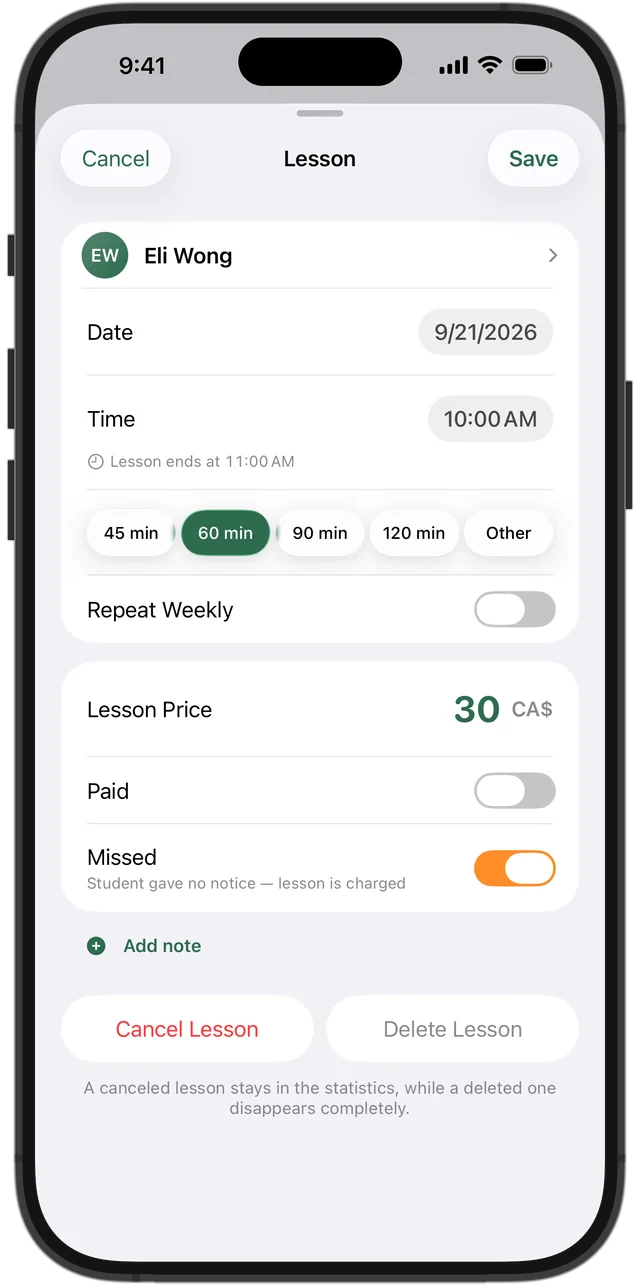
Missed vs cancelled: why it matters
Missed means the student didn't show up and didn't give notice. That lesson is usually charged, so the template counts it like a lesson you taught. Cancelled means it was called off in advance: it isn't charged, and any prepaid money stays on the student's balance.
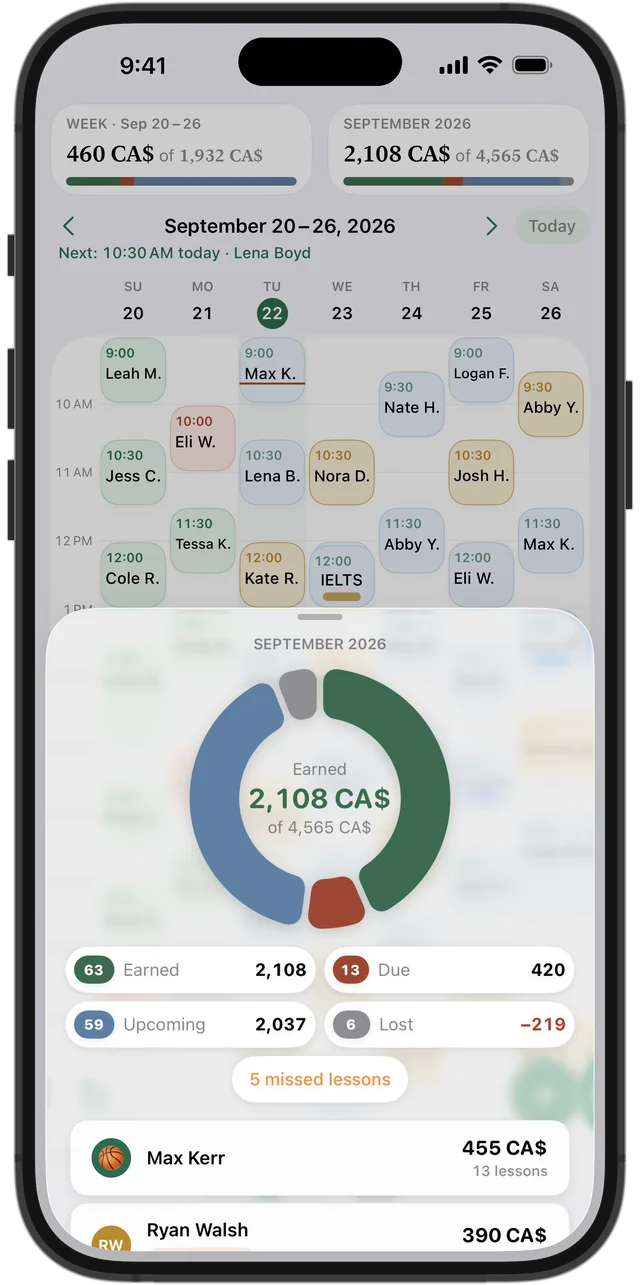
Keep cancelled rows instead of deleting them — at month's end they show how many lessons, and how much income, cancellations cost you. In Squool the same thing is a single Missed switch in the lesson form.
When a spreadsheet is enough
If you have up to about ten students, each pays after the lesson, and your schedule rarely changes, the template does the job. Log lessons once a week, check balances once a month, done.
A spreadsheet also wins when you want your own figures for your tax return or like building your own charts. An app won't give you that kind of freedom.
When the spreadsheet starts to hurt
The trouble comes with volume: twenty students, weekly lessons you retype every week, groups where each kid pays a different price, parents who e-Transfer a month ahead. Opening a spreadsheet on your phone between lessons is clumsy, and one forgotten row quietly breaks a balance.
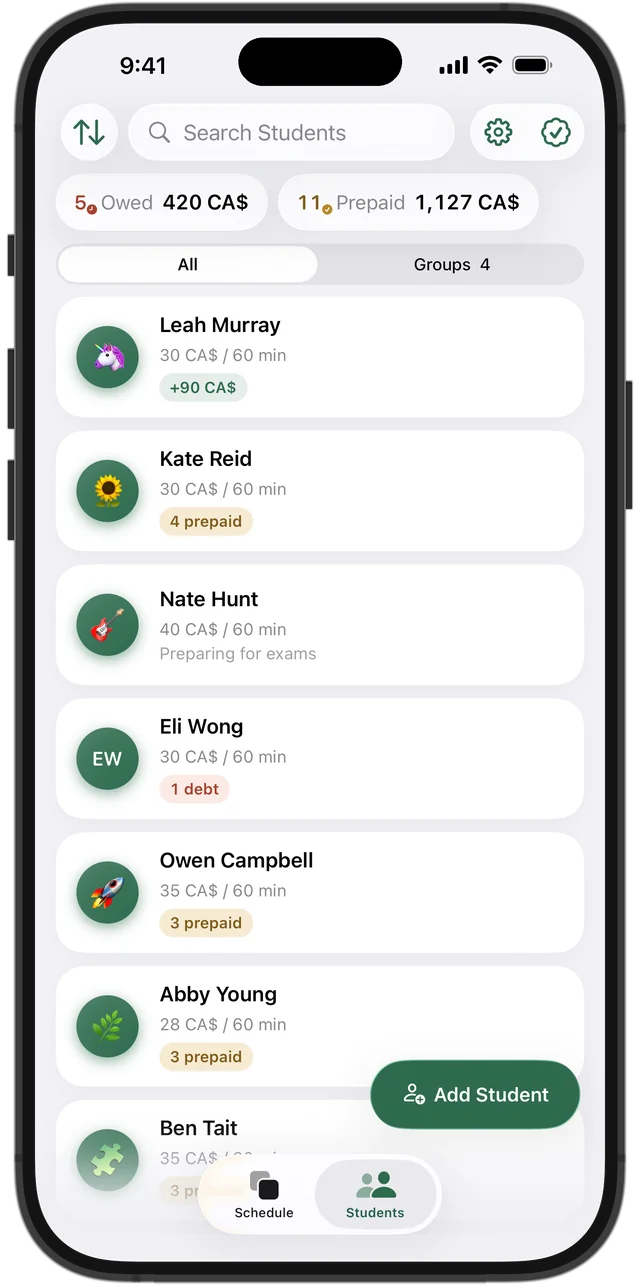
That's where Squool helps — a tutoring app for iPhone, iPad and Mac. You create a weekly lesson once, log a payment with Add Funds, and lessons are paid automatically, oldest first. Who owes and who prepaid sits at the top of your student list. 14 days free, no card required, and your data stays on your device and in your own iCloud.
Questions and answers
Is the tutoring spreadsheet template really free?
Yes. The .xlsx file downloads without an account or email, and you can use it for as long as you like.
Does the template work in Google Sheets?
Yes. Upload the file to Google Drive and open it with Google Sheets — the formulas keep working. It also opens in Excel and in Numbers on Mac or iPad.
How much do tutors make per month in Canada?
It depends entirely on your rate and hours: price per lesson × lessons per week × about 4.3 weeks, minus cancellations. Put your own numbers into the calculator on this page to see your monthly and yearly figure.
Should a tutor charge for a missed lesson?
Usually yes: if a student no-shows without notice, the lesson is charged. A lesson cancelled in advance isn't. Agree on the rule with students and parents up front.
Can I import this spreadsheet into Squool?
No. You add students with their name and price by hand and enter each current balance as a payment. If your lessons are already in Google or Apple Calendar, Squool can bring students and weekly lessons over from there.
Read also
Spreadsheet or app
An honest comparison for tutors: when a notebook, Excel or a Google Sheets tracker is enough, which columns it needs, and when a tutoring app saves time.
Tracking payments
A simple way for tutors in Canada to track payments: one balance per student, prepaid lessons, e-Transfers, who owes you. On paper, in a sheet or an app.
Tutoring income
How a private tutor in Canada can see real monthly income: what's earned, what's still due, what's planned and what cancellations cost. A method and an app.
Try it free for 14 days
No card required. Subscribe only once the app has proven it's worth it to you.
Download on the App Store